Contents7
At a glance
In thirty seconds- StakeHanding agents tasks that commit the business requires reading what they will do, controlling what they see and reviewing what they did.
- MechanismA strict graph, validated before it runs, where a context strategy composes what each model receives and every turn is traced.
- ProofThe engine, its web studio and the zf command-line tool, published on GitHub and used to prepare my monthly invoicing.
- ImpactAn agent becomes auditable: you know what it saw, what it did and where a human decided.
- LimitsZedflow is a preview with no external user; part of the execution is designed but not implemented yet.
- Client
- MC Studio, research and development
- My role
- Designer and sole developer
- Setting
- Internal project
- Team
- Solo · 1 person
- Technologies
 Rust
Rust TypeScript
- Vue.js
- ADK-Rust
The starting point
AI agents can chain actions. What is most often missing is the ability to read what they will do before launching them, to control what they see, and to find out afterwards why they acted as they did. Without that, it is hard to hand them anything but tasks without consequences.
What I built
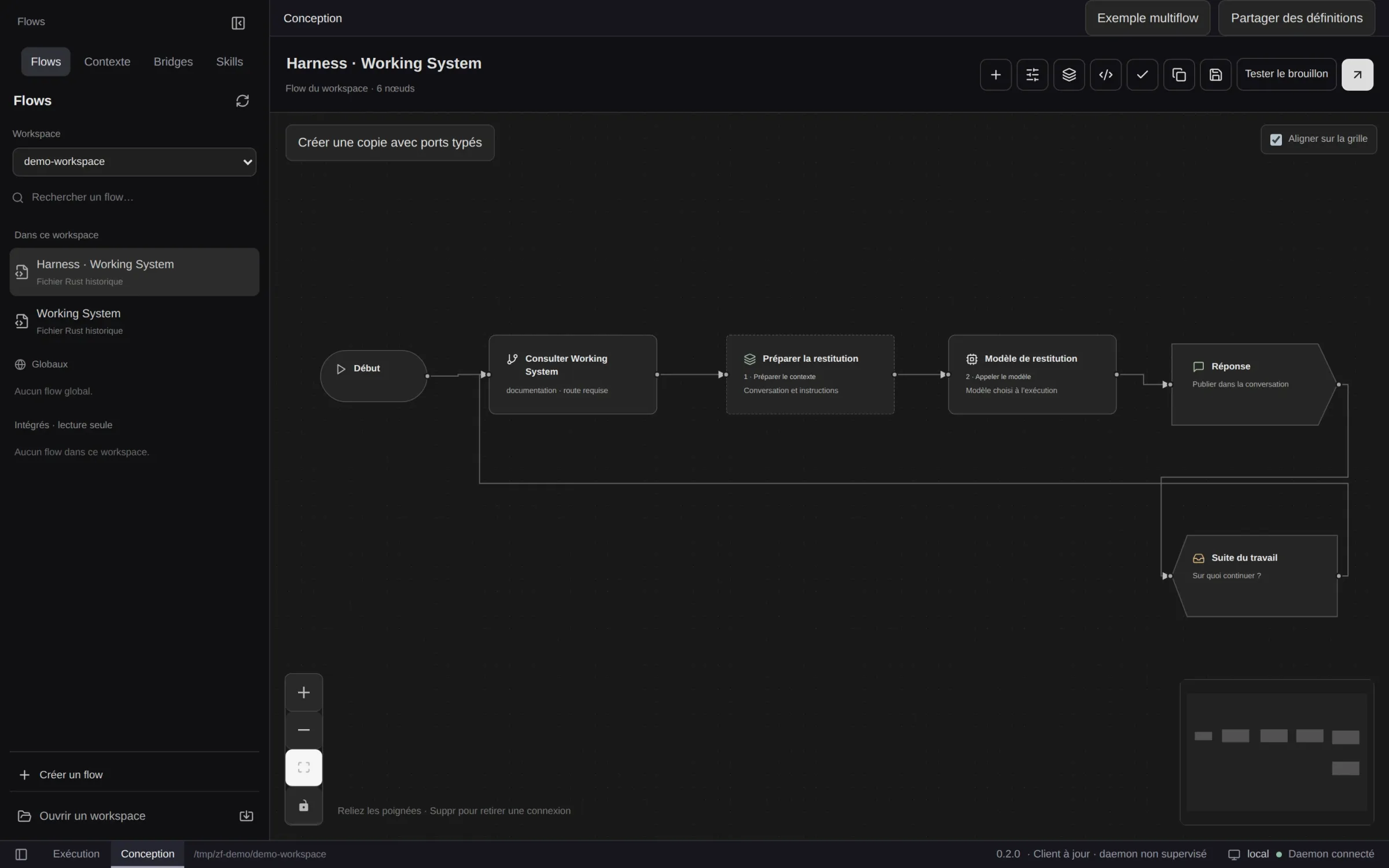
Zedflow is an agent flow engine and studio1. A flow is a typed graph, checked before it runs: an invalid transition or a badly declared value is refused with a precise diagnostic, instead of failing in the middle of a run.
Zedflow builds on ADK-Rust, whose graph…
Zedflow builds on ADK-Rust, whose graph workflows follow the same principles as LangGraph.
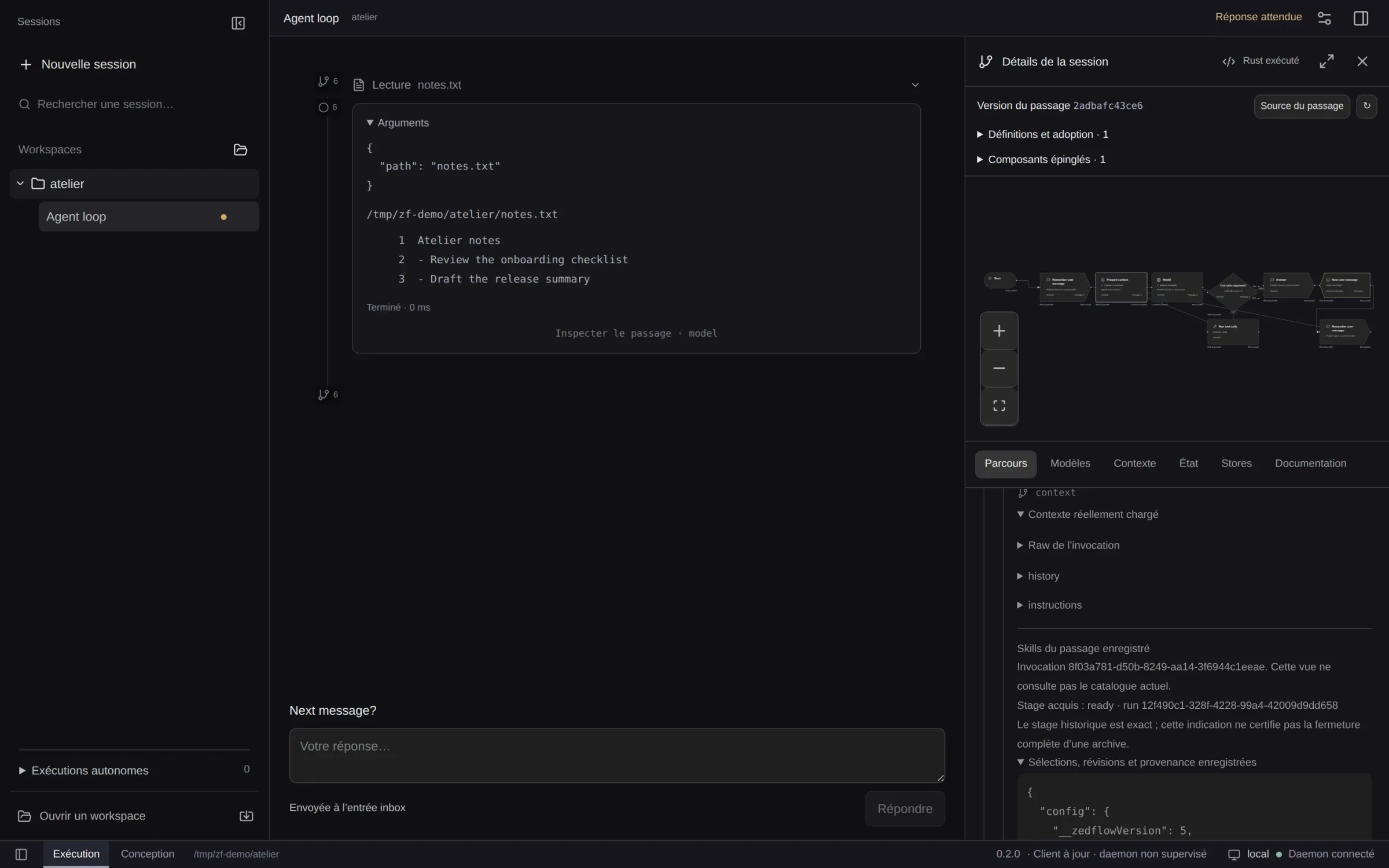
At every turn, a context strategy decides, block by block, what the model receives; state lives in typed stores, not in the prompt. Bridges connect flows to each other, each with its own responsibility, context and tools. Human approvals are steps of the graph, checked on typed data: an agent can prepare an invoice, it cannot send it until the person in charge has approved.
What the evidence shows
The code is public, with the engine, the web studio and the command-line tool2. You can try it locally with a demo provider, without an account or a real model. Every turn can be reviewed in the studio: what the model received, which tools ran, what changed.
690 commits, all mine, from 8 July 2026…
690 commits, all mine, from 8 July 2026 to 3 October 2026 (default branch of the public repository, as of 12 October 2026).
What it changes
For a client, this approach makes an agent auditable, and that is the condition for handing it tasks that commit the business. I apply it to myself first: Zedflow prepares my monthly invoicing, and nothing leaves without my approval3. It is also a testing ground for what I recommend to my clients: useful, bounded agents whose every decision can be reviewed.
Agents prepare the invoice and email…
Agents prepare the invoice and email drafts; sending waits for my explicit approval, a step of the graph.
Limits
- Formats and interfaces still change, and part of the execution is designed but not implemented yet.
- No external user to date; the only real use is internal to MC Studio.
- The licence, PolyForm Noncommercial 1.0.0, reserves commercial use for a separate agreement.
Share and reuse
The link, the plain text and visuals ready for LinkedIn.