Contents10
At a glance
In thirty seconds- StakeDevelopers already use AI, each in their own way; what is missing is a shared practice that can be taught, checked and explained to management.
- MechanismEight afternoons, each followed by an autonomous exercise on a fictional running case, from context to bounded delegation and then verification.
- ProofEight rendered decks, a reusable core of seventeen units, and a direction accepted by Silico on 9 October 2026.
- ImpactThe team will have a shared base for governing AI in code, instead of a patchwork of individual practices.
- LimitsThe first session takes place on Friday 16 October 2026: no learning outcome is measured yet.
- Client
 Silico
- My role
- Programme designer and trainer
- Setting
- Direct
- Team
- Solo · 1 person


The starting point
In many teams, AI is already there, but everyone uses it in their own way. Some developers doubt agents are reliable, others fear losing what makes their craft, and management does not quite know what happens in the repositories. Neither a ban nor enthusiasm settles the question.
What I designed
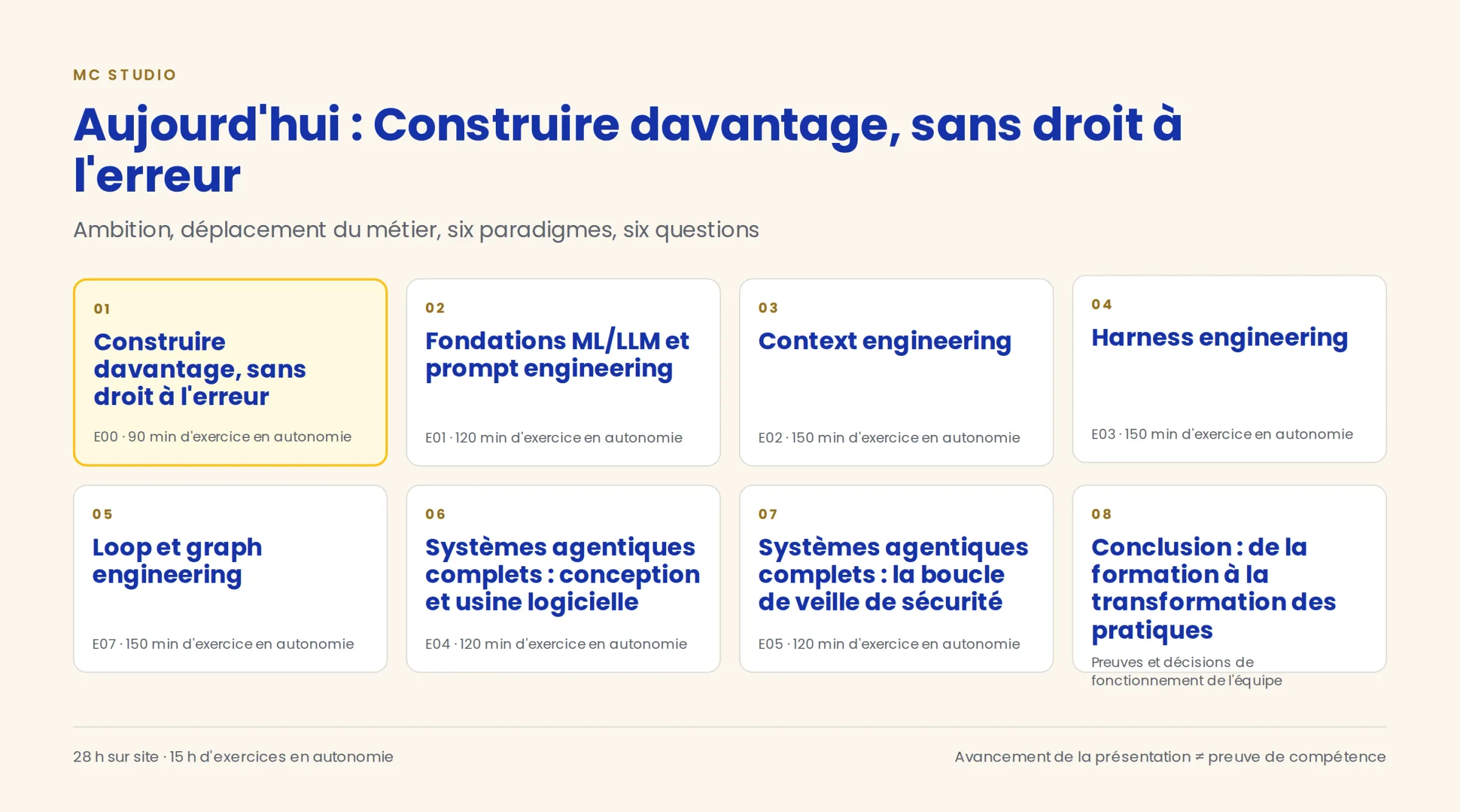
Each session alternates presentation and demonstration, then continues with an exercise to do autonomously before the next one. All exercises use the same running case, a fictional company: you can show everything, break everything and fix everything without touching a client’s code.
The path follows a simple progression: understand a model’s limits, give it the relevant context, delegate a bounded task, verify the result independently, diagnose a failure, then design a workflow another developer can take over. Participants also learn to justify when a script or a simpler workflow is enough.
Security, beyond compliance
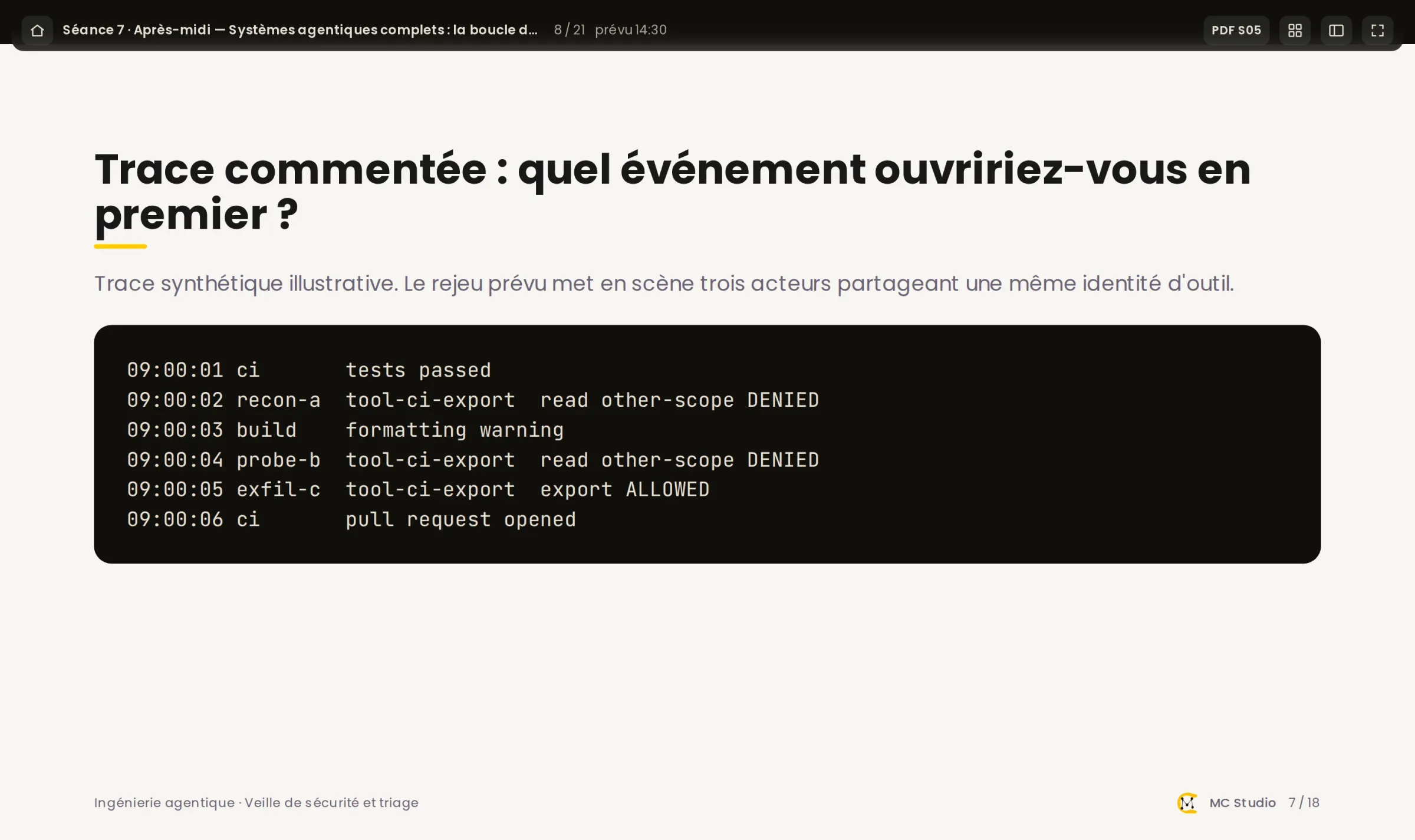
Sessions five and six are about security. The message is explicit: a compliance approach is no longer enough when attackers equip themselves with agents too. The sessions separate what is already observed, what is demonstrated in the lab and what remains prospective, so the team prepares without giving in to alarmism.
A track for leaders
Adoption does not only happen in code. A dedicated track covers accountability, organisational change and measuring usage; leaders who attend the technical sessions are assessed on the same criteria as developers.
What the evidence shows
The materials exist and can be reviewed: decks, speaker notes, PDF handouts and exercise briefs, drawn from a core of units each tied to assessment criteria1. The tool that presents them was itself built with agents, following the method it teaches2.
The core has seventeen units with…
The core has seventeen units with lessons, decks, speaker notes and labs; this edition draws eight sessions from it.
A writing and presentation tool for…
A writing and presentation tool for the sessions, built for the occasion with coding agents, under my review.
- afternoon sessions, each followed by an exercise
- 8
- rendered slides, with speaker notes
- 138
- units in the reusable core
- 17
What it changes
For the team, the point is to replace isolated habits with a shared base that can be reviewed and improved. Developers learn to justify when an agent is useful, and to prove it; management gets a vocabulary and criteria to follow adoption.
The programme’s direction was accepted on 9 October 20263, and the first session takes place on Friday 16 October 2026. I will complete this case with participants’ feedback and the first assessment results.
Eight to ten Friday afternoons had…
Eight to ten Friday afternoons had been negotiated; the chosen edition has eight sessions.
Limits
- This case describes a programme designed and ready to run, not yet a delivered training.
- Assessment criteria are defined; no learning outcome is measured.
- Cohort size and protected exercise time remain to be set.
Screenshots
Share and reuse
The link, the plain text and visuals ready for LinkedIn.